
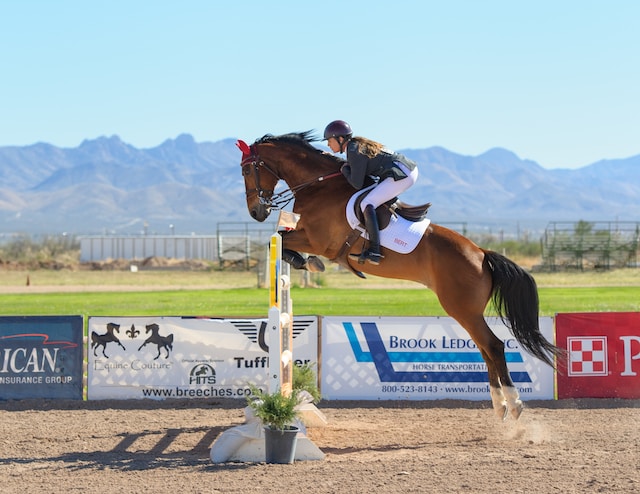
If your horse has confidence, it will be easy to motivate them to jump. However, this problem can be resolved with slow but sure training and patience. Teach your horse to maintain pace and train their eyes to see a reasonable distance. This will help them avoid “chipping in” or taking a short spot.
Wing Standards are Wide
When choosing horse jumps, you want products that are durable and designed to withstand frequent use. Wing standards, like all other equestrian obstacles, spend much of their time outdoors and must be strong enough to withstand a lot of abuse over time. You can find a wide variety of wing standard jumps available online. They are commonly seen at horse shows and in training arenas. Some are made of aluminum, which is a durable material that also helps with weight distribution and can be used for different height adjustments. Others are made of PVC or wood, with their strengths and weaknesses. PVC is lighter than wood, but it cannot be routed as quickly and may splinter or crack. It is also more difficult to move for course changes than wooden wings and poles.
They Are Sturdy
The wing standard horse jump is one of the most durable jumps available. It’s high-density polyethylene and can withstand weather elements and fast-moving horses. It also features marked measurements, making it easy to align jump poles. The wings of the jump extend out from the poles to create a funnel effect that helps direct the horse’s approach. This makes it easier to clear the obstacle, boosting confidence and safety in the arena.
In addition, the wing standards are easy to set up and maintain. They are lightweight, which reduces stress on the jump’s joints. They are also easy to assemble and disassemble for course changes. They are also a safe alternative to wooden jumps for young or inexperienced horses. This is because they offer a soft surface that reduces impact damage and prevents splinters. Moreover, they are more resilient than wood, which can wear down quickly. It’s important to note that using different colors can desensitize the horse to the jump and lead to erratic behavior.
They Are Easy to Clear
There are a variety of different types of horse jumps. The wing standard is one of the most popular and is an essential part of a training program for competitive horses. A wing standard consists of a pair of vertical poles with wings on top that create a funnel effect as the horse approaches the obstacle. The wings help to guide the horse over the jump without putting them in danger of landing on a loose foot or tripping. Other horse jumps include an oxer or spread (also called an offset oxer) and a wall. These are usually a mix of heights and incorporate both widths and angles. If you build a wing standard, the distance between the verticals must be appropriate for your horse’s stride length. If the jumps are too big, they may prevent your horse from becoming confused and tripping. They should also be well-maintained and inspected for loose or missing feet, splinters, or cracks.
They Are Suitable for All Levels
When used at a low height, wing standards are easy for beginner horses to clear. This makes them a great training tool for young or inexperienced horses that may be intimidated by a wide obstacle. It is essential that this type of jump is adequately introduced to the horse and that it is given time to adjust to it before using it in competition. Higher-level show jumping courses present more challenges for horses and riders. This can include increasing the height and width (“spread”) of the fences and altering their position in the arena, for example. In addition, some courses require a specific number of obstacles to be completed in a particular order. Refusing any of these elements will result in penalties or elimination from the competition. This is why novices and young horses need to practice jumping with the help of a qualified coach. A coach can ensure the horse is confident and capable of clearing each jump before introducing them to competition courses.